
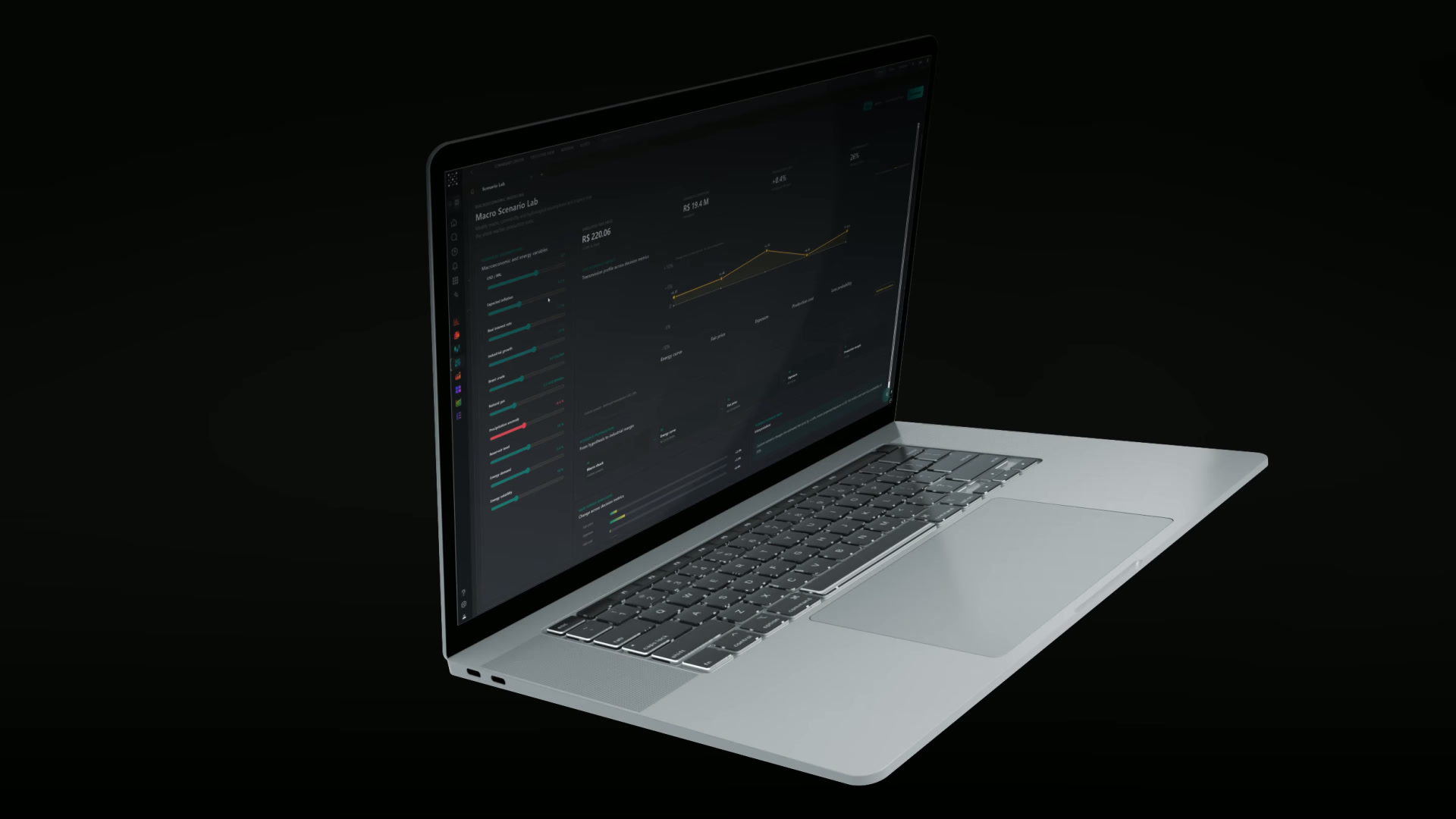
See deterioration before it is reported.
Credit quality rarely collapses in a single month. It drifts across segments, often where aggregate metrics hide it. Decision-grade inference qualifies the drift as evidence while there is still time to act.
Use cases
Where credit, liquidity and model risk break, and how the stack holds.
One fold per pain: what breaks, how Grand Thera's decision-grade AI stack resolves it, and an interactive figure to explore.
01 / 04
The pain
Credit deterioration surfaces a quarter too late.
Portfolio drift hides inside aggregates. By the time default rates move in the monthly report, the losses are already priced into the book.
How Grand Thera solves it
TheraOS reconciles origination, behavior and macro data by segment. AIT Agents qualify persistent drift as evidence and escalate before the quarterly review.
Deterioration qualified months earlier, with probability, exposure and an owner.
Interactive figure · demonstration data
02 / 04
The pain
Liquidity stress is modeled once a month.
Funding concentration, deposit behavior and market moves change daily. Static stress tests describe yesterday's balance sheet.
How Grand Thera solves it
Scenario engines run continuously against live positions, and the board's liquidity floor becomes an enforced threshold, not a slide.
Liquidity buffers tracked against the board's appetite in real time.
Interactive figure · demonstration data
AIT Agents
The agents that address these problems.
Choose an agent to see what it watches and what it brings to a decision. If yours is not here, we build it.
03 / 04
The pain
Models disagree and nobody can say why.
Risk, finance and business lines run separate models on separate data. Committees debate numbers instead of decisions.
How Grand Thera solves it
Computational epistemology reconciles heterogeneous models, discounts shared bias and turns them into one calibrated probability with an interval.
One defensible number per decision, with the evidence attached.
Interactive figure · demonstration data
04 / 04
The pain
Regulators ask for the trail behind the decision.
Model risk management and audit need lineage, assumptions and validity windows that spreadsheets cannot reproduce.
How Grand Thera solves it
Every inference is packaged as an auditable artifact: sources, transformations, uncertainty, approvals and expiry.
Audit-ready decisions without reconstruction work.
Interactive figure · demonstration data
Credit drift
Where the portfolio is moving.
Decisions supported
Across the balance sheet.
Credit risk monitoring
Segment-level deterioration qualified before it surfaces in aggregate reporting.
Portfolio exposure
Concentrations and correlated exposures made visible with their uncertainty.
Liquidity analysis
Funding and cash-flow stress traced to its operational and market drivers.
Market risk
Volatility regimes and their transmission into positions and limits.
Stress scenarios
Adverse but plausible scenarios evaluated against current exposure.
Emerging threats
Signals that do not fit existing risk taxonomies, kept under review until they qualify or dissolve.
Walkthrough
An artifact a credit committee can interrogate.
“Grand Thera demonstrates rare technical depth and their technology handles complex decision scenarios with real precision.”