
Working Paper v1.1 · Preprint · Conceptual framework
Published· Sep 2026Beyond Ontology
Computational Epistemology as a Layered Inference Machine
A Conceptual Framework for Separating Signal from Noise in Decision-Making
Fernando Negrini (lead author) · Hugo Dias · Darlan Parucker Lueders · Caroline Assis
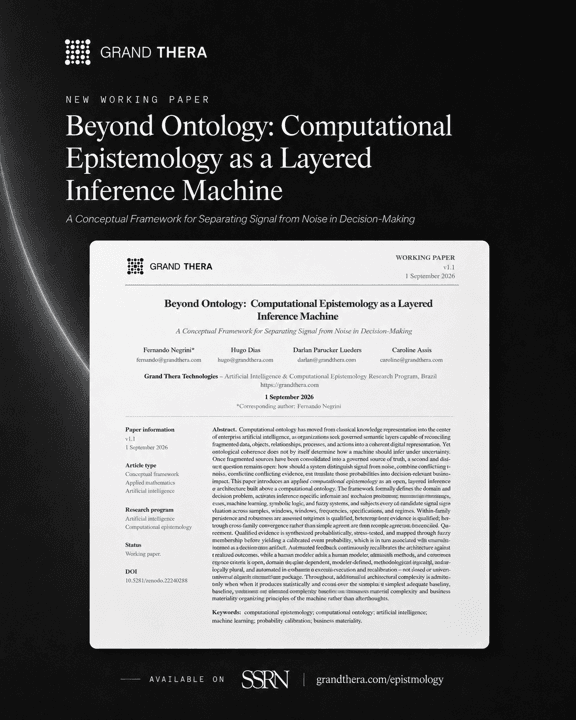
Ontological coherence does not determine how a machine should infer under uncertainty. The paper introduces an applied computational epistemology: an open, layered inference architecture built above a computational ontology. Candidate signals are interrogated by heterogeneous engine families, subjected to repeated evaluation across samples, windows, frequencies, specifications and regimes, qualified, reconciled through dependence-aware convergence, calibrated into an event probability and mapped to business impact as an auditable artifact. A human modeler retains governance, and added complexity is admitted only when it yields statistically and economically material gains over the simplest adequate baseline.
- DOI (Zenodo)
- 10.5281/zenodo.22240288
- Also listed (SSRN)
- 10.2139/ssrn.7392618
- Issued
- 2026-09-01
- License
- CC BY 4.0
- Resource type
- Preprint · open to review
What the paper claims
- Inference is more defensible when the decision is framed before models are selected.
- Candidate signals should survive admissible perturbations before they are promoted.
- Cross-family synthesis should discount shared dependence and preserve conflict.
- Probability becomes decision-relevant only when linked to impact and an auditable trail.
Open empirical program
- 01Test whether cross-window persistence improves out-of-distribution performance.
- 02Estimate which perturbation sets best separate structure from sample artifacts.
- 03Measure how shared data and inductive bias should discount convergence.
- 04Compare a single model, a homogeneous ensemble, an ontology-centered system and the full machine on held-out data.