
The scientific basis of a decision.
Decision-grade AI is not a larger model. It is a disciplined path from governed data to qualified evidence, from evidence to calibrated probability, and from probability to financial consequence.
In this section
- CapabilitiesAI and machine learning, forecasting, exposure, capital optimization, early signals, alerting, ontology and agents.
- Computational EpistemologyA layered inference architecture above the data foundation, L0–L9.
- Uncertainty & EvidenceWhy a signal must survive being challenged before it informs a decision.
- Decision IntelligenceFrom calibrated probability to financial consequence and action.
- Model ArchitectureSpecialized model families. Language models as interfaces, not foundations.
- Research PublicationsWorking papers, DOIs and the open research program.
Four questions
Every inference must answer them before it reaches a decision.
- Q1
What exactly is being inferred?
Event, horizon, population and materiality threshold are fixed before any model is chosen. Without a frame, a model answers a question nobody asked.
- Q2
Does it survive being challenged?
A candidate signal is re-run across windows, frequencies, resamples and specifications. What does not persist is noise, however precise it looked.
- Q3
Is the agreement independent?
Three models agreeing on shared data and shared assumptions is one opinion repeated. Evidence is weighted by dependence, not counted.
- Q4
What is the consequence?
A probability becomes decision-relevant only when it is mapped to loss, revenue, liquidity or disruption, with its interval and expiry intact.
Architecture
Specialized inference. Language at the interface.
Computational epistemology
Sophistication has no epistemic value by itself.
From the working paper · §9
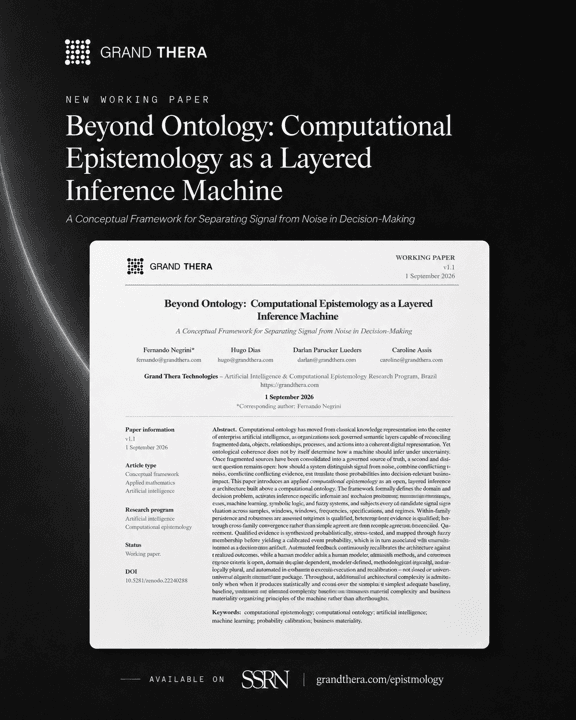
Beyond Ontology: Computational Epistemology as a Layered Inference Machine
Fernando Negrini et al. · Working Paper v1.1 · 2026
Ontology structures what is available to the machine. Computational epistemology structures what the machine is permitted to conclude from it.
Executive insights