

Skip to content
Grand Thera
TheraOS Command Center: world map of signals with the Rotterdam Lane signal selected

Beyond ontology.

Ontology structures what is available to the machine. Computational epistemology structures how the machine is permitted to infer from it. A governed source of truth is the beginning of inference, not its justification.

Active research· Working paper v1.1

The inferential gap

Governed does not mean justified.

Enterprise AI has invested heavily in semantic layers that reconcile objects, relations, lineage and permissions. That work is necessary. It answers what exists and how it is connected.

It cannot certify whether a pattern survives another sample, another window or a change of regime. More governed data can still generate more spurious patterns, and a fitted model cannot certify its own epistemic status. The missing function is a disciplined protocol for attempted refutation.

From state to justified inference

  • T · structured domain state
  • ⇏
  • E · persistent, qualified, calibrated, decision-relevant evidence

L0–L9 architecture

One precondition. Nine inferential layers.

L0 makes governed evidence possible. L1–L9 determine what the machine may conclude, how uncertainty survives and who remains accountable. Select a layer.

Loading figure: One precondition. Nine inferential layers.

Cross-family convergence

Agreement is not truth.

Three engines can repeat one shared flaw. Evidential weight depends on heterogeneous, sufficiently independent corroboration, not on a raw vote.

Loading figure: Agreement is not truth.

Probability → impact → artifact

A probability is not yet a decision.

Loading figure: A probability is not yet a decision.

Limits

A framework to test, not a result to believe.

The paper is a conceptual framework. It specifies an architecture and the empirical program needed to validate it: whether cross-window persistence improves out-of-distribution performance, which perturbation sets best separate structure from artifacts, how shared data should discount convergence, and how the full machine compares with simpler alternatives on held-out data.

The machine may propose a structural revision. It cannot promote that revision on its own. Modeler approval remains required.

Working Paper v1.1 · Preprint · Conceptual framework

Published· Sep 2026

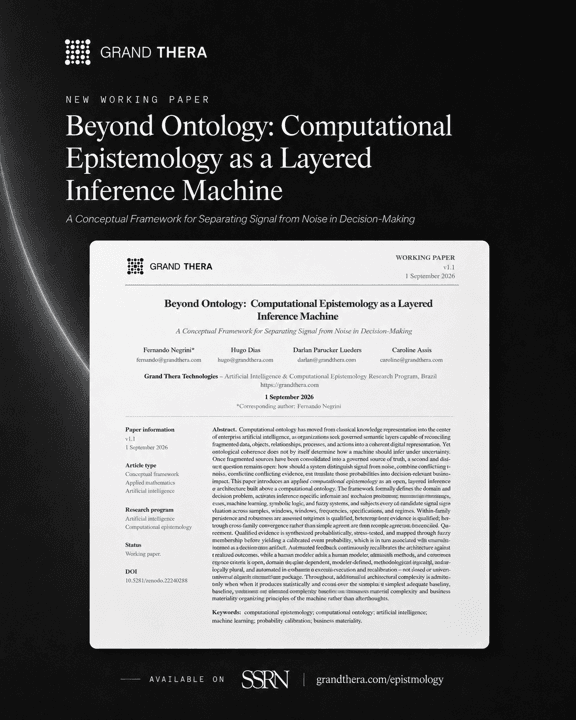
Beyond Ontology

Computational Epistemology as a Layered Inference Machine

A Conceptual Framework for Separating Signal from Noise in Decision-Making

Fernando Negrini (lead author) · Hugo Dias · Darlan Parucker Lueders · Caroline Assis

Ontological coherence does not determine how a machine should infer under uncertainty. The paper introduces an applied computational epistemology: an open, layered inference architecture built above a computational ontology. Candidate signals are interrogated by heterogeneous engine families, subjected to repeated evaluation across samples, windows, frequencies, specifications and regimes, qualified, reconciled through dependence-aware convergence, calibrated into an event probability and mapped to business impact as an auditable artifact. A human modeler retains governance, and added complexity is admitted only when it yields statistically and economically material gains over the simplest adequate baseline.

Also listed (SSRN)
10.2139/ssrn.7392618
Issued
2026-09-01
License
CC BY 4.0
Resource type
Preprint · open to review

What the paper claims

  • Inference is more defensible when the decision is framed before models are selected.
  • Candidate signals should survive admissible perturbations before they are promoted.
  • Cross-family synthesis should discount shared dependence and preserve conflict.
  • Probability becomes decision-relevant only when linked to impact and an auditable trail.

Open empirical program

  1. 01Test whether cross-window persistence improves out-of-distribution performance.
  2. 02Estimate which perturbation sets best separate structure from sample artifacts.
  3. 03Measure how shared data and inductive bias should discount convergence.
  4. 04Compare a single model, a homogeneous ensemble, an ontology-centered system and the full machine on held-out data.

On Medium

Writing on computational epistemology.

Not the most elaborate machine. The smallest one capable of defending its inference.